Marketing attribution models: the number you can take to your CFO
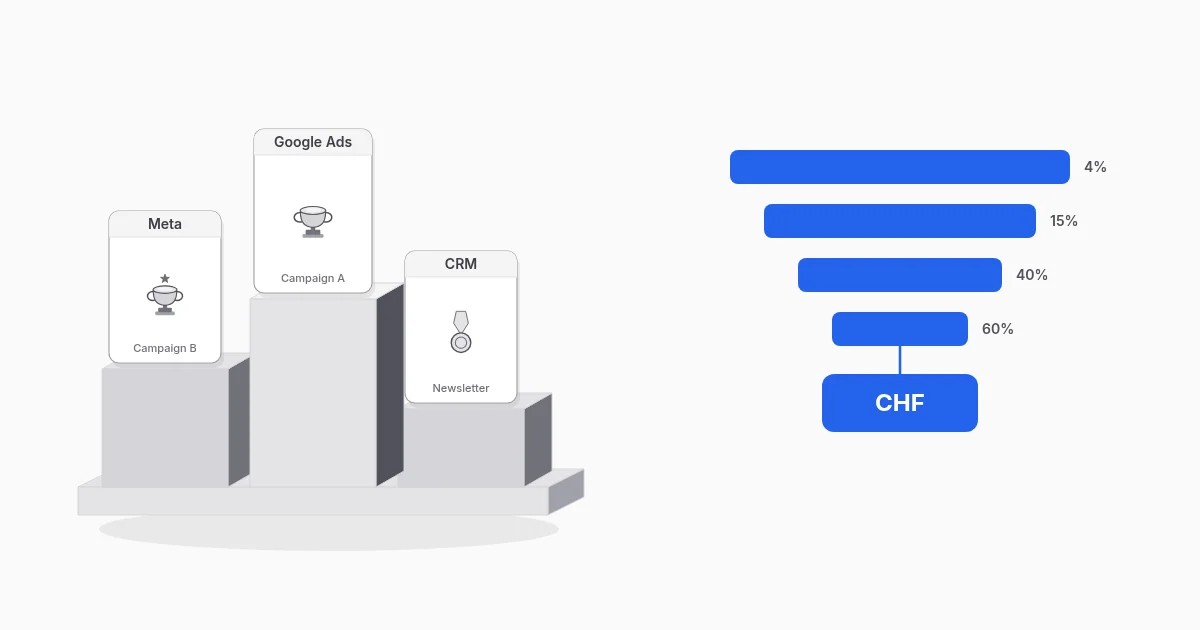
It's the budget round for next year. Google Ads shows Campaign A as the clear winner. Meta reports almost as many conversions for Campaign B. And the CRM says the biggest deal of the quarter came in through a newsletter and was closed over the phone weeks later. Your CFO has one question: "So which number is right?"
Marketing attribution models are meant to answer exactly that. In practice they often make it harder, because every platform runs its own model. This post covers which number to trust first, why a more sophisticated model rarely helps, and how to steer marketing when the deal closes months after the click.
1. What an attribution model actually decides
An attribution model doesn't measure what caused a sale. It only shares out the credit among the touchpoints it can see.
With last click, the final click before the conversion gets all of it. Multi-touch models spread the credit across several touchpoints, either by a fixed rule or by an algorithm. Both can be calculated correctly and still crown different winners, because they answer different questions.
In Google Ads and GA4 the menu has been short since 2023. Google retired first click, linear, time decay and position-based; in GA4 those models have been unavailable since November 2023. That leaves mainly last click and data-driven attribution. Plenty of guides still walk you through the old models as if you could pick them in your account.
2. Why every platform names a different winner
Google Ads, Meta, GA4 and your CRM count different things and use their own time windows and models. That's why the numbers rarely line up.
- Different events: Meta may count a click on "Save" as a conversion, Google Ads a submitted form, and your CRM only a qualified lead.
- Different windows: some platforms also claim conversions from people who only saw an ad and never clicked it.
- Each platform only sees itself: Google Ads knows nothing about the LinkedIn post, Meta nothing about the Google search. Each one takes the credit.
- The close rarely comes back: when the deal is won in the CRM, the ad platform usually doesn't hear about it.
Add up the conversions from every platform and you quickly get more deals than sales ever saw. If that sounds familiar, it's the same trap described in our post on customer acquisition cost (CAC).
3. Which number to trust first
The order is simple: the CRM first, then cross-channel web analytics such as GA4, and the conversions reported by Google Ads and Meta last.
The CRM, but only if it's actually right. What we often see: sales doesn't keep the deal stages up to date, and nobody has properly defined what "closed won" means. Then the CRM isn't a reliable source either. In that case the real revenue usually sits in the ERP, in finance's own books. That's the number your CFO is most likely to accept.
Web analytics, for example GA4. It assigns conversions across all channels, not just its own ads. A quick sanity check: the total number of conversions in GA4 should never be higher than the number of leads in your CRM for the same period. If it is, something is being counted twice. Our post on how to calculate cost per lead shows how that happens.
Google Ads and Meta come last. They attribute in their own favour. Their figures are useful for optimising inside each platform, not for the budget meeting.
The Executive Education programme at the University of Zurich was at exactly this point. According to the University of Zurich Executive Education case study, conversations stayed at "How many leads did we get?" instead of "What revenue did LinkedIn actually bring us last year?" Once tracking and the CRM were connected, 90% of customer journeys were tracked, up from almost none, and figures were 100% comparable across departments. At CKW (part of the Axpo Group), the CRM used to be tied to marketing only at conversion level. Today campaigns are 100% attributed, with 95% data quality.
Connecting tracking and the CRM takes more than writing UTM parameters into CRM fields. They only capture the last click, meaning the session in which the form was submitted.
Instead, send the GA4 client ID to the CRM with every form submit, for example into HubSpot. It's the cookie ID GA4 uses to recognise a visitor. Store the same ID in GA4 as a user-scoped custom dimension, and you can join every lead and deal to all of that person's sessions, with channel and campaign, from first touch to last.
The join only works for visitors who consented to analytics cookies, for example via the consent banner and Consent Mode, and it then follows the revDSG and your privacy notice.
Only once that join is in place do simple models and a weighted funnel work on real CRM outcomes. You still need UTM parameters in your campaign links so GA4 can see the channels, just not in the CRM as your attribution method.
Checklist: is your CRM ready to be the source?
- Sales updates deal stages as they change, and stale deals with no activity get closed.
- What counts as "won" is written down (signed contract, invoice or enrolment) and applies to every team.
- Every form submit writes the GA4 client ID into the CRM, and the same ID is stored in GA4. That way each lead and deal is joined to the full journey.
- Phone enquiries are linked back to the journey where possible, for example by asking "How did you find us?" or by using a separate tracked number.
- The UTM parameters in your campaign links follow fixed rules so GA4 can see the channels. Here's why you lose money without a proper UTM parameter system.
- GA4 conversions are not higher than CRM leads for the same period.
- CRM revenue roughly matches ERP revenue. If it doesn't, the ERP wins.
- Google Ads and Meta conversions are never added together.
Only once these boxes are ticked is a debate about models worth having.
4. Why data-driven attribution is rarely the answer
The usual advice is to switch on Google's data-driven attribution and be done with it. We're sceptical, for three reasons:
- It mostly rates Google: in Google Ads, the model only shares credit among Google ads. Organic social posts and referral traffic don't feature at all.
- It's a black box: you see the result, but not why a channel gets the share it does. That's very hard to defend in front of a CFO.
- It needs volume: Google itself recommends at least 200 conversions and 2,000 ad interactions within 30 days. Many Swiss B2B firms and education providers are far below that for qualified leads.
The same goes for the models often sold as the next step up, such as Markov chains or Shapley values. They need large data volumes that Swiss companies often don't have, and without them they're mostly just complicated.
Day to day, a simple rule works better. For example, show first touch and last touch side by side. You can do that once every deal is joined to the full journey via the GA4 client ID. First touch tells you which channel brings in new people. Last touch shows what tipped them into getting in touch. Everyone understands that rule, and it applies equally to every channel.
5. Long sales cycles: steer with a weighted funnel
If a deal closes six months after the first click, you can't wait that long to steer your campaigns. Look at the early signals instead, meaning qualified leads and qualified opportunities, and weight them by their historical close rate.
Here's how it works:
- Pull the deals from the last 12 to 24 months out of your CRM.
- For each stage, work out how many went on to be won. That's the historical close rate from that stage.
- For each campaign or channel, count how many leads and deals are currently at each stage. Each record counts once, at its current stage.
- Weighted value = count × historical close rate × average deal value.
An example for one campaign in one quarter, with an average deal value of CHF 24,000:
| Current stage | Count | Historical close rate from this stage | Weighted value |
|---|---|---|---|
| New lead, not yet qualified | 80 | 4% | CHF 76,800 |
| Qualified lead | 30 | 15% | CHF 108,000 |
| Qualified opportunity | 10 | 40% | CHF 96,000 |
| Proposal sent | 4 | 60% | CHF 57,600 |
| Total weighted pipeline | CHF 338,400 |
Example figures for illustration
This tells you within a few weeks whether a campaign is building pipeline, rather than half a year later. Two campaigns with the same number of leads can look very different once you see how many of those leads get qualified.
The rates have to come from your own CRM, not from a benchmark, and you recalculate them every quarter. You can only break the funnel down by campaign or channel if every deal is joined to the full journey via the client ID. If the CRM only holds the UTM parameters from the form, you're steering by last click. A weighted funnel is only as good as the deal stages behind it, which is why the checklist above comes before any model.
6. What to show your CFO
Your CFO needs a number that ties back to the accounts, and a clear rule for how it's produced. You can spare them the debate about models.
| Question | Which number | Only if… |
|---|---|---|
| How should Google bid inside Google? | Data-driven attribution in Google Ads | The conversion event is a real business outcome, not a micro-event |
| Which channel brings in new leads and enquiries? | First and last touch side by side, joined via the client ID | The GA4 client ID is stored on every lead and deal |
| Which campaign is building pipeline right now? | Weighted funnel in CHF | Deal stages are kept up to date |
| What did marketing contribute to revenue? | Won deals from the CRM or ERP | "Won" is defined and revenue matches the ERP |
A simple number you can defend beats any model
A complex attribution model doesn't fix a shaky data foundation, it just hides it. Once your CRM stages and definitions are right, and leads are joined to the full journey via the client ID, a simple rule is usually enough. A weighted funnel then shows you early where the budget should go.
Want to know whether your data is up to it? In the Data Quality Check we review your tracking and data quality, set up the customer journey through to your CRM, and work out with your team in a workshop which number belongs in the budget meeting. Or get in touch for a short call.
FAQ
What's the difference between last-click and data-driven attribution? With last click, the final click before the conversion gets all the credit. Data-driven attribution uses an algorithm to spread it across several touchpoints. In Google Ads it only considers Google ads when doing so.
Why do Google Ads, Meta and GA4 report different conversion numbers? The platforms count different events, use different time windows and only see their own touchpoints. Ad platforms also tend to give themselves the credit. That's why you shouldn't add their numbers together.
Is data-driven attribution worth it if we only close a few deals a month? Usually not. Google recommends at least 200 conversions and 2,000 ad interactions in 30 days. With less data, simple rules such as first and last touch are more reliable and easier to explain. That assumes you join leads and deals to the full journey via the GA4 client ID.
How do I steer marketing when deals close months after the click? With a weighted funnel. You weight qualified leads and opportunities by their historical close rate from your CRM. Within a few weeks you can see which campaign is building pipeline.
Which number belongs in the report for the CFO? Won deals from your CRM, provided sales keeps the stages up to date and "won" is clearly defined. Otherwise, revenue from the ERP. Ad platform conversions don't belong in that report.
Is it enough to write the UTM parameters into the CRM? No. The UTM parameters from the form only show the last click. Instead, send the GA4 client ID to the CRM with every form submit and store it in GA4. For consenting visitors on the same browser, you then see the journey through to the deal. You still need UTM parameters in the campaign links so GA4 can see the channels.
Written by
Dashflow Team