Customer Acquisition Cost (CAC): The Number Your CFO Actually Wants to See
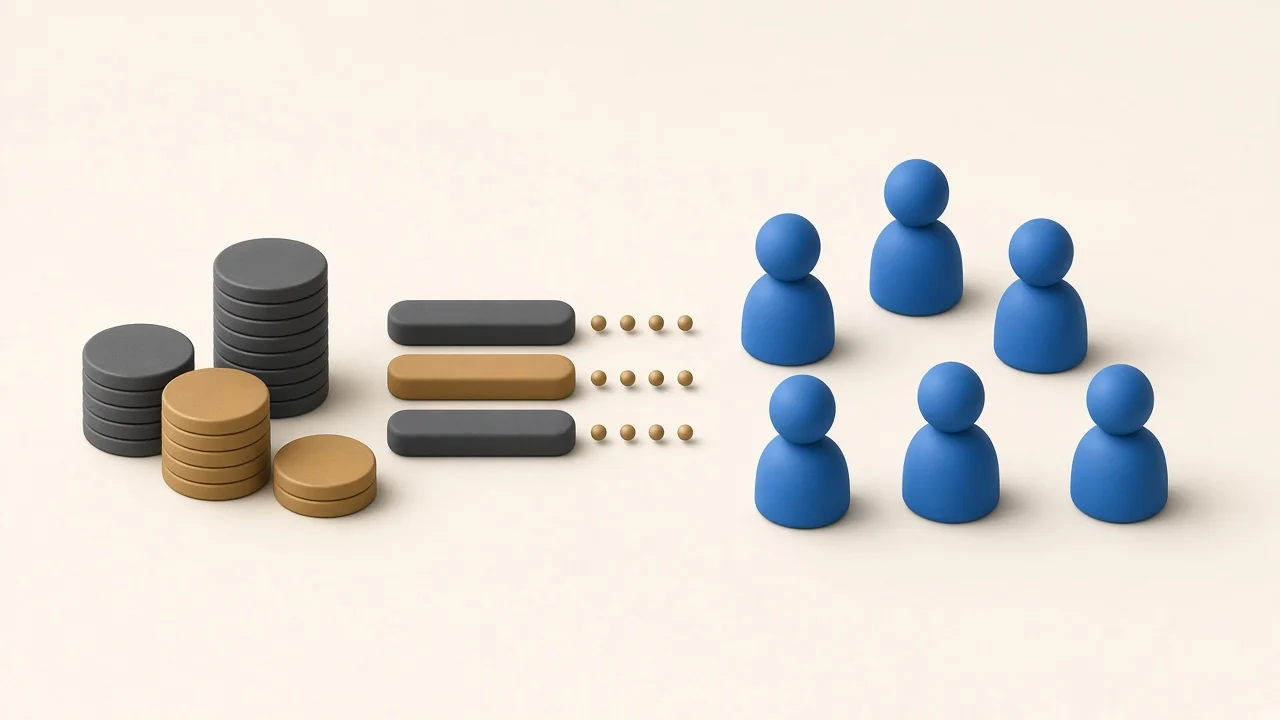
When marketing shows its numbers in the budget meeting, the CFO often looks sceptical. Fair enough. Google Ads reports 40 conversions, LinkedIn 25, and GA4 shows yet another number. Every platform gives itself the credit. Add them up and you get more deals than sales has ever seen.
Customer acquisition cost, or CAC, works differently. It shows what a new customer costs you, across all channels and based on the deals in your CRM. Finance understands this number, and it lets you talk budget with your CFO on equal terms.
1. CAC explained simply
Customer acquisition cost = marketing and sales costs ÷ number of new customers
Here's an example with made-up numbers. A B2B company spends the following in one quarter:
| Cost item | Amount |
|---|---|
| Media spend (Google, LinkedIn, Meta) | CHF 30,000 |
| Agency and tools | CHF 12,000 |
| Share of marketing team | CHF 18,000 |
| Share of sales | CHF 30,000 |
| Total | CHF 90,000 |
Example figures for illustration
In the same quarter the company wins 15 new customers. So CAC is CHF 90,000 ÷ 15 = CHF 6,000 per customer.
If you only count marketing costs, it's CHF 60,000 ÷ 15 = CHF 4,000. Both can make sense. What matters is that you say which one you mean. For the conversation with your CFO, the number including sales is usually the right one, because it shows what a customer really costs the company.
2. CPL vs. CAC: what's the difference?
Cost per lead shows what an enquiry costs. CAC shows what a customer costs. The whole sales process sits in between.
In the example above, the CHF 60,000 in marketing costs brings in 300 leads. That's a cost per lead of CHF 200. Sounds good. But only 15 of those leads become customers, or one in twenty.
Cost per lead is useful for steering campaigns. But it tells you nothing about whether those leads turn into revenue. A channel with cheap leads can have the highest CAC if sales can't do much with those leads. That's why CAC belongs on the table for budget decisions, not cost per lead.
3. The three most common calculation mistakes
Mistake 1: The costs are incomplete
Many teams only count media spend, because that number comes straight out of the platforms. Agency fees, tools, content and the team's time are left out. CAC looks lower than it is, and the CFO will notice as soon as they look at the books. After that, they trust your other numbers less too.
Mistake 2: Customers are counted wrong
A typical mistake is at the bottom of the fraction. Typical cases:
- Conversions from the ad platforms get added up. Because every platform claims the deal for itself, the same customer is counted two or three times.
- Leads or form fills are counted instead of new customers. Then you're really calculating cost per lead.
- Existing customers, renewals or upsells are counted as new customers.
There's only one reliable source: your CRM. That's where you can see which deal was actually won and whether it's a new customer.
Mistake 3: Costs and customers don't line up in time
In B2B it often takes weeks or months from first contact to closed deal. If you divide November's costs by November's customers, you're measuring customers whose leads came in over the summer. After a strong campaign, CAC looks bad at first, then suddenly great a few months later.
So look at CAC over a quarter or longer, not month by month. It gets even more accurate if you assign each customer to the month of their first contact.
4. Working out CAC per channel properly
One CAC across everything is a good start. For budget decisions, though, you want to know which channel brings in customers. Here's how:
- Keep the source: Every lead needs its origin (UTM parameters, click ID) in the CRM, all the way to the won deal. We explain how to do that without a new tool in How to measure customer journeys from clicks to ROI.
- Agree on one rule: Decide which channel gets credit for a customer, for example the first touch. The rule doesn't have to be perfect. It has to apply to every channel in the same way and not change every month.
- Split costs properly: Media spend can be assigned to a channel directly. Fixed costs like team and tools are either shown separately or split by a set ratio.
With made-up numbers, it looks like this:
| Google Ads | ||
|---|---|---|
| Media spend | CHF 20,000 | CHF 20,000 |
| Leads | 150 | 60 |
| Cost per lead | CHF 133 | CHF 333 |
| New customers according to CRM | 4 | 8 |
| CAC (media spend only) | CHF 5,000 | CHF 2,500 |
Example figures for illustration
On cost per lead, Google Ads looks like the clear winner. On CAC, LinkedIn costs half as much. If you only look at cost per lead, you move budget in the wrong direction.
5. What to show your CFO
Your CFO doesn't need click-through rates. They want to know whether the money is well invested. One page is enough:
- CAC across all channels, as a trend over the last few quarters.
- CAC per channel, calculated with the same rule.
- A comparison with what a customer is worth, for example the contribution margin in the first year. Only then is it clear whether CHF 6,000 per customer is a lot or a little.
- The definition, in writing: which costs are included, what counts as a new customer and which attribution rule applies.
- The gaps, stated openly. If phone enquiries still land in the CRM without a source, say so. That builds more trust than a number that looks too good.
Once you've agreed on the definition with finance, the next budget meeting is about the decision, not about which number is right.
An honest CAC gets you more budget than a pretty one
A CAC based on clean CRM data may well be higher than what the platforms report. But you can defend it. And when you can show which channel brings in customers at what price, the budget conversation with your CFO gets a lot easier.
Want to work out your CAC per channel properly? Get in touch and we can go through your budget numbers together in a short call. If you first want to know whether your leads are being tracked correctly, start with the free GA4 tracking review.
Read more: How to calculate cost per lead: why your number is probably wrong and Why you lose money without proper UTM parameter systems
FAQ
How do I calculate customer acquisition cost? Divide your marketing and sales costs for a period by the number of new customers in the same period. Decide beforehand which costs are included.
What's the difference between CAC and cost per lead? Cost per lead shows what an enquiry costs. CAC shows what a new customer costs. In B2B only some leads become customers, so CAC is usually much higher.
Where do the customer numbers for CAC come from? From your CRM. Ad platform conversions don't work, because every platform credits deals to itself, so customers get counted more than once.
How often should I calculate CAC? In B2B with longer sales cycles, a quarter usually makes more sense than a month. Otherwise the number swings a lot, because costs and closed deals happen at different times.
Written by
Dashflow Team