How to Measure Your Customer Journeys from Clicks to ROI (Without a New Tool)
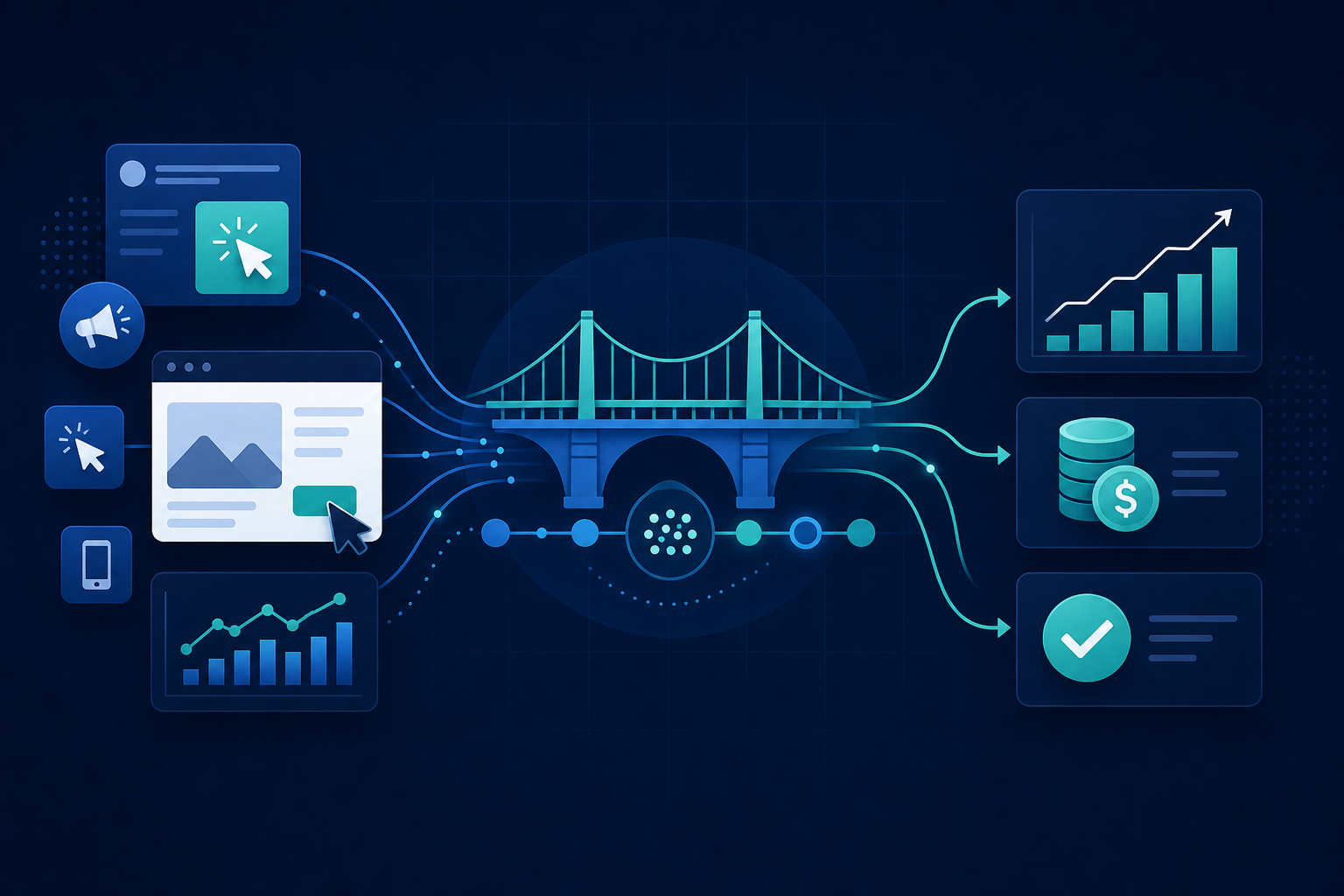
Marketing platforms report clicks and sessions. Your CRM or shop system reports revenue and customer lifetime value (LTV). Yet for most mid-sized companies, those two worlds rarely connect in a practical, actionable way.
That disconnect is not theoretical. It drives misallocated budgets, inflated cost-per-acquisition figures, and repeated investment in channels that feel productive but deliver limited incremental business value.
This post outlines a pragmatic, tool-light approach: link digital touchpoints to actual CRM business outcomes using assets you likely already own, web analytics, your CRM or shop stack, and basic export/join workflows. No new platform license required.
1. Why You Should Measure Your Customer Journey
Real-life operational pain points
- Marketing optimizes on platform conversions that often represent only the final click, while finance and sales see revenue that cannot be reliably traced back to specific campaigns or landing pages.
- Budget discussions become contentious because no one can prove which early-stage awareness efforts actually contribute to later-stage closed-won deals.
- Customer acquisition cost (CAC) stays wrong, inflated or understated, leading to poor decisions on scaling paid channels or pausing organic ones.
- Cross-functional teams operate with competing versions of the truth, eroding trust and slowing strategic alignment between marketing, sales, and product.
Business consequences
- Repeated over-spend on bottom-funnel channels while upper-funnel activities that seed future LTV go underfunded.
- Inability to identify which traffic sources deliver not just one-time buyers but profitable, repeat customers.
- Regulatory and privacy pressures (for example, cookie consent rates in Europe) already erode visibility; without a structured measurement layer, the remaining data becomes even less reliable.
Organizations that solve this gain what we describe in our methodology: a single source of truth from first touch to revenue, not another dashboard silo.
2. Why Moving from Last-Click Conversions to Attributed Customer Lifetime Value Makes Sense
Limitations of last-click attribution in practice
- It systematically over-credits the final interaction (often branded search or direct navigation) and under-credits earlier touchpoints that shaped consideration and intent.
- In B2B or considered-purchase scenarios, the journey can span weeks or months; last-click ignores the cumulative effect of multiple exposures.
- Platform algorithms trained solely on last-click events optimize for short-term vanity metrics rather than long-term profitable growth.
Advantages of an attributed LTV view
- More accurate ROI per channel, campaign, and creative.
- Better budget allocation between acquisition and retention.
- Marketing incentives aligned with metrics that matter: recurring revenue, margin contribution, and churn reduction.
Realistic caveats
This shift requires accepting modeling assumptions and imperfect data matching. It is not perfect science, but for most operating environments it is still markedly superior to last-click.
The University of Zurich Executive Education case illustrates the shift: from vanity metrics and ~0% journey visibility to 90% customer journeys tracked and revenue-connected KPIs like CAC and ROAS.
3. Why You Should Not Simply Send Last-Click UTM Parameters to Your CRM
Pushing the UTMs from the final session into your CRM feels like a quick win. In practice, it creates more noise than signal.
Core technical and practical shortcomings
- UTM parameters captured at the final session are tied to one browser session and cannot be reliably linked to the full interaction history in Google Analytics (or similar) for the same user.
- CRM records become fragmented: the same customer may appear with different “last-click” sources depending on device or browser at conversion time.
- There is no persistent user identifier between anonymous web analytics and known CRM records, so true journey stitching at scale is impossible.
- CRM reports stay noisy and non-actionable, teams ignore them or revert to platform dashboards that lack revenue context.
Poor UTM governance makes this worse. If your tagging is inconsistent, even last-click CRM fields will disagree with analytics. See why you lose money without proper UTM parameter systems for the foundation work that Step 4 below depends on.
Downstream business impact
- Ad platforms keep receiving incomplete or misleading conversion signals, perpetuating inefficient bidding and creative optimization.
- Leadership cannot answer: “Which combination of channels delivers our highest-LTV customers?” without manual, error-prone spreadsheet work.
4. How to Achieve This: Practical Step-by-Step Implementation
This requires technical effort and ongoing maintenance, but it avoids licensing another martech platform. The stack: web analytics (GA4 or equivalent), CRM/shop, and scheduled exports joined in one table.
Step 1: Send persistent cookie IDs back to your CRM or shop system
Generate or capture a first-party persistent identifier (for example, a hashed cookie value) on the website and pass it into the CRM or shop database at lead creation or purchase, server-to-server or via a hidden form/checkout field.
Pain addressed: Breaks the anonymity barrier between web sessions and known customer records without relying solely on email or login.
Feasibility: Typically 1–2 weeks of developer time for a mid-sized site, plus consent management to stay compliant.
Step 2: Enhance cookie persistence with server-side tracking
Implement server-side tracking where possible. Extend cookie lifetime through first-party domain strategies and refresh logic on repeat visits.
Pain addressed: Mitigates rapid cookie decay and consent-driven data loss that fragments journeys after a few days.
Scalability: Works for most traffic volumes; monitor consent rates and define fallbacks for opted-out users.
Step 3: Create a unified single source of truth
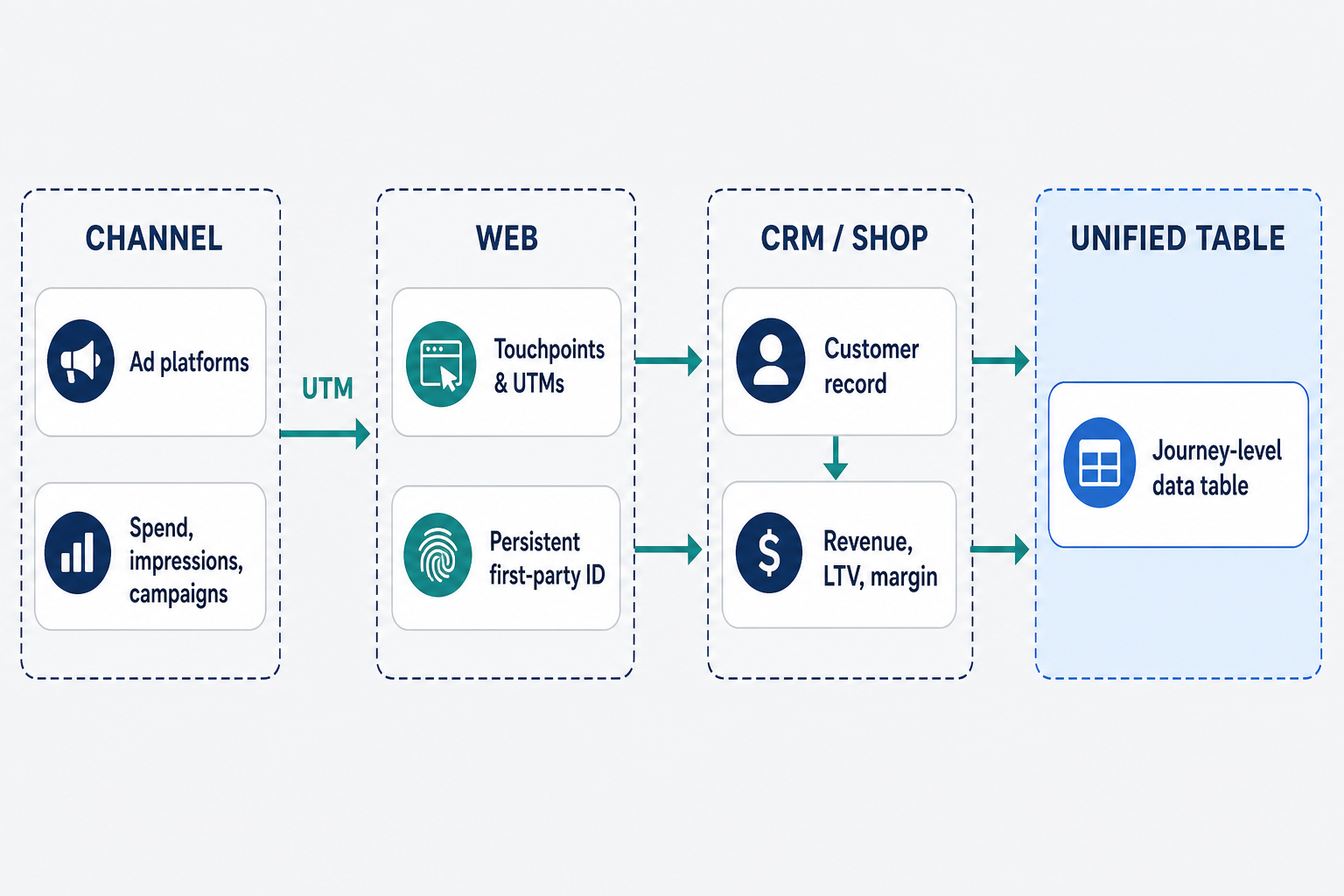
Define a central data table (or view) that combines:
- Exported channel/ad platform data
- Web analytics exports
- CRM records
This is a scheduled pull-and-join process, not a “data lake” rebranding exercise. The goal matches how Dashflow structures implementation: one reconciled dataset teams can trust in weekly reviews.
Step 4: Connect channel data and web data via source parameters
Ensure consistent UTM (or equivalent) tagging at campaign and landing-page level. Join those parameters across ad platforms and web analytics exports.
Pain addressed: Eliminates discrepancies between ad platform reports and web analytics.
Use a free UTM builder and naming templates so teams do not invent new parameter spellings every launch.
Step 5: Connect web data with CRM via the cookie ID
Use the persistent cookie ID as the common key to stitch anonymous web sessions to known CRM customer records.
Pain addressed: Full-journey visibility without manual row-by-row matching.
Step 6: Pull all data into one journey-level table
Export and merge datasets (SQL, Python, Google Sheets, or BigQuery for smaller volumes) into a single table with:
- Touchpoints and traffic sources (ordered in time)
- CRM outcomes: revenue, LTV, margin, churn flags, repeat purchase
Feasibility: Realistic up to low-seven-figure revenue with existing BI or light scripting; larger volumes benefit from scheduled ETL. Ongoing maintenance is required whenever tracking or CRM fields change.
Resulting data model
You end up with a flat (or lightly modeled) table mapping each CRM customer to the sequence of sources and touchpoints before conversion. That table is the foundation for attribution modeling, without buying additional software.
| Layer | What it holds | Join key | | --- | --- | --- | | Channel | Spend, impressions, campaign IDs | UTM / campaign params | | Web | Sessions, events, source/medium | UTM + persistent cookie ID | | CRM | Lead/customer, revenue, LTV | Persistent cookie ID + customer ID |
5. Outlook: Feed business KPIs back into advertising platforms
With the unified table in place, export aggregated, privacy-safe performance metrics, attributed LTV, repeat-purchase rate, margin per source, as custom conversion events or value-based bidding signals.
Realistic expectations:
- Algorithms can optimize toward outcomes that matter rather than last-click volume.
- Gains are incremental and depend on data quality, volume, and platform support for value-based optimization.
- Privacy regulations limit some data flows; expect signal loss.
- The feedback loop still needs periodic validation against P&L.
Long-term benefit: Marketing decisions use the same numbers finance and leadership review, reducing internal friction and improving capital allocation.
If you are unsure whether your current data foundation can support this, start with an honest baseline: our AI readiness assessment for marketing data surfaces silos, quality gaps, and reporting trust issues in minutes.
Conclusion
Measuring customer journeys from clicks to ROI is not effortless or perfectly accurate. It is achievable with focused internal effort, and it delivers materially better insight than disconnected platform and CRM reporting.
Start small: pick one high-value traffic source, implement Steps 1–2, and validate a handful of CRM records against their web touchpoint history. Expand channel coverage and attribution rules once the join is stable.
Next steps
- Audit your tracking layer before stitching journeys, broken GA4 setup undermines everything downstream. Book a free GA4 tracking review →
- Talk through your CRM and analytics stack with our team. Book a strategy call →
Written by
Dashflow Team