How to measure lead quality: why a cheap cost per lead can still cost you money
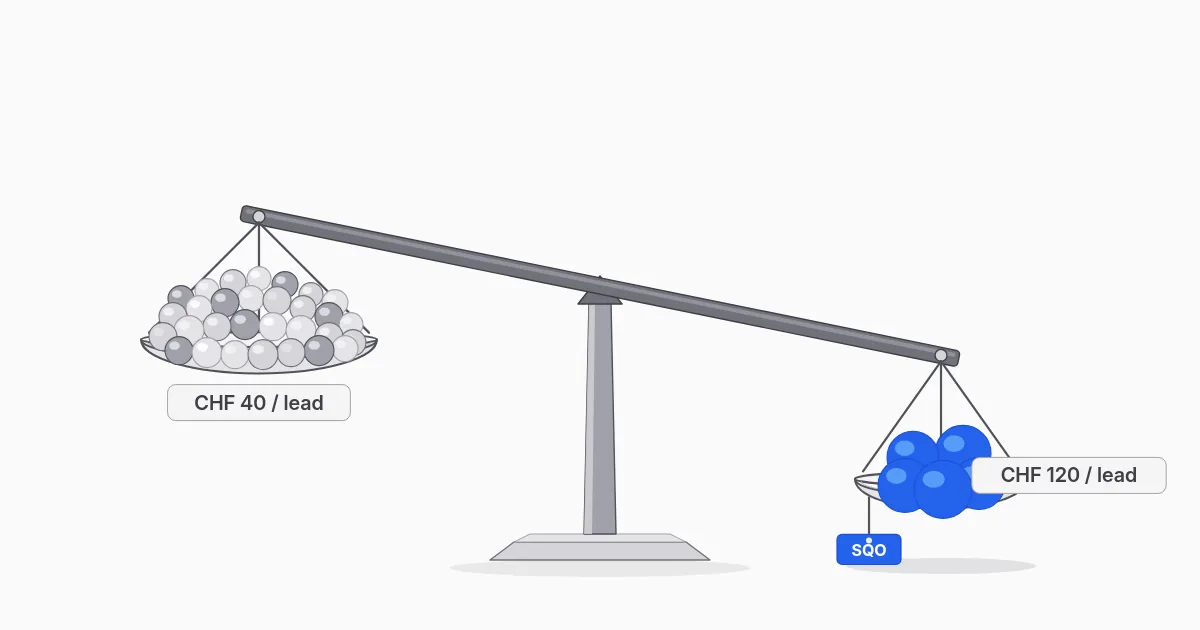
A typical example: it's the autumn budget round. The social campaign brings in leads at CHF 40 each, Google Search at CHF 120. The maths looks obvious: move money into the cheap campaign. Three months later, sales asks where all these enquiries are coming from, because they can't do anything with them. Your CFO wants to know why the pipeline isn't growing when you've never had so many leads.
Lead quality decides whether a cheap lead is actually cheap. This post shows how to measure lead quality through to the opportunity and why a "bad" lead is often just an early one. It also covers which signal to send back to Google Ads so your budget goes where revenue is made. The figures to watch are the cost per qualified lead and the cost per opportunity.
1. Why a cheap cost per lead can still cost you money
Cost per lead tells you what a completed form costs. It doesn't tell you whether that form turns into a conversation, a proposal or a deal.
What we often see: teams move budget into the cheapest channels and campaigns, then wonder why sales isn't following. The lead count goes up; the pipeline doesn't. In the budget meeting, marketing turns up with good-looking numbers while sales has very little to show.
Before you talk about quality, the lead count itself has to be right: no forms counted twice, and no enquiries missing. Our post on how to calculate cost per lead covers that. This one picks up at the next step: what happens to those leads.
2. A "bad" lead is often just an early lead
Many of the leads sales writes off aren't bad at all. They come from an earlier stage of the customer journey and need different handling.
Someone searching Google for a solution usually has a problem already, and often a budget. Those leads tend to be far better qualified. Someone who clicks an ad on LinkedIn or Meta may not have been looking at all. That's not the campaign's fault: paid social often sits at the start of the journey.
The trouble starts when every lead is treated the same. If sales calls every social lead the next day as if it were a search enquiry, the conversation is short and the verdict quick. It works better with a separate nurturing track for each type of lead. Early leads might get a newsletter with content and invitations until they're ready to talk. Search enquiries go straight to sales.
For your budget, that means: don't compare paid social with search after a week. Look at what has become of those leads a few months on.
There's a measurement problem on top: many reports only count the last click. If someone first arrives via a LinkedIn ad and comes back through search weeks later, search gets all the credit for the deal, and the ad looks as if it did nothing. So judge channels on the whole journey. Why the last click isn't enough is covered in marketing attribution models: the number you can take to your CFO.
3. What lead quality means: MQL, SQL, SQO
Lead quality is the share of leads that move on to the next stage of the funnel, all the way to the deal. So you measure it with a set of conversion rates rather than a score out of 100.
The funnel varies with the business model. With our clients, it's usually this one:
- MQL (marketing qualified lead): fits your target audience and has shown real interest, such as an enquiry or a download.
- SQL (sales qualified lead): sales has checked the lead and wants to talk to them.
- SQO (sales qualified opportunity): there's a concrete need, a budget and a next step, such as a proposal.
- Closed: the deal is won.
- Revenue: what the deal actually brings in.
The exact definitions matter less than marketing and sales writing them down together and not changing them every few weeks. Otherwise you can't compare the rates from one quarter to the next.
This is also where the most common argument starts. Sales often sees marketing as responsible right up to the close. We see the funnel as a shared performance: marketing brings in the right people, and sales turns them into customers. If the SQO rate drops, it could be the leads, the follow-up, or both. You'll only settle that with numbers both teams accept.
4. Compare channels on cost per SQO, not cost per lead
What should decide your budget is what a qualified opportunity costs you. So work out the cost per SQL and per SQO for each channel.
An example, with the same budget for both channels over three months:
| Campaign A (paid social) | Google Search | |
|---|---|---|
| Media spend | CHF 12,000 | CHF 12,000 |
| Leads (MQL) | 300 | 100 |
| Cost per lead | CHF 40 | CHF 120 |
| SQLs | 45 | 40 |
| MQL → SQL rate | 15% | 40% |
| Cost per SQL | CHF 267 | CHF 300 |
| SQOs | 8 | 16 |
| SQL → SQO rate | 18% | 40% |
| Cost per SQO | CHF 1,500 | CHF 750 |
Example figures for illustration
On cost per lead, campaign A is three times cheaper, and on cost per SQL the two are almost level. Per SQO, search then costs half as much. Had you shifted budget on cost per lead, you'd have bought fewer opportunities for the same money.
That doesn't automatically mean switching campaign A off. First check whether the 255 leads that never became SQLs are genuinely a poor fit, or simply too early. If some of them turn into opportunities after a few months of nurturing, the sums look different. So always note the time period next to the table, and run it again later on the same leads.
What a won customer costs in total is the job of customer acquisition cost (CAC).
5. How to link quality back to the channel
You only get these rates by channel if every lead and deal in your CRM is joined to that person's whole journey. Writing the UTM parameters from the form into the CRM won't do it, because that only shows you the last click.
So we do it differently: every form submit sends the GA4 client ID, the ID from the _ga cookie, to the CRM, for example HubSpot. The same ID is stored in GA4 as a user-scoped custom dimension. That lets you join every MQL, SQL and SQO to all of that person's sessions, channels and campaigns, from the first touch to the last. That way you can also see, say, that a deal started with a social ad and came back through search weeks later.
Storing the GA4 client ID in the CRM links it to a named contact, so your privacy notice must cover that. The join only applies to visitors who have agreed to analytics cookies, and it has to fit the revDSG (the Swiss Data Protection Act). You still need UTM parameters, but in your campaign links, so that GA4 can recognise the channels. There's more on the method in marketing attribution models: the number you can take to your CFO.
What about phone enquiries?
In many Swiss B2B firms, deals are still done over the phone. Call-tracking tools exist, but in our experience they aren't very accurate. A simple question during the call is more reliable: "How did you hear about us?" Sales logs the answer in a fixed CRM field with set options rather than free text. That way, phone leads stay visible in the funnel too.
6. Send a weighted funnel back to Google Ads
If Google Ads only sees the completed form, it will keep buying the leads that are cheapest to get a form out of. So send every funnel stage back to Google Ads as an offline conversion, with a value that rises the further down the funnel it is.
The values don't have to reflect your real revenue. What counts is the ratio between the stages: an SQO should be worth as much more than an MQL to Google as it really is to your business. Google's own help page on value-based bidding says the values "can be real economic values, like revenue or proxy values, like a lead score".
Template: values for your weighted funnel
Derive the values from your historic conversion rates:
- Pull the leads and deals from the last 12 to 24 months out of your CRM.
- For each stage, work out what share was eventually won.
- Give a won deal a reference value, for example 1,000.
- Value of a stage = reference value × share won from that stage.
- Recalculate the values every quarter.
An example: historically, 30% of MQLs become SQLs, 50% of SQLs become SQOs, and 25% of SQOs are won.
| Stage | Share won from this stage | Value sent to Google Ads |
|---|---|---|
| MQL | 30% × 50% × 25% = 3.75% | 38 |
| SQL | 50% × 25% = 12.5% | 125 |
| SQO | 25% | 250 |
| Closed | 100% | 1,000 |
| Revenue | closed value × deal value ÷ average deal value | 2,000 for a deal twice the average size |
Example figures for illustration
In this example, an SQO is worth more than six times as much to Google as an MQL. That teaches Google's bidding that a cheap enquiry that never goes anywhere counts for little. For the technical setup, see Google's guide to setting up your offline conversions.
Offline conversions are the feedback loop for bidding inside Google Ads. Which channel brings leads of real quality is still something you measure through the client ID in your CRM, so you also see LinkedIn, your newsletter and organic search.
An anonymised Swiss insurance broker was facing exactly this: "We had a lot of unqualified leads and did not know where to shift the money to increase our ROI." Its CEO puts the difference down to sending the right signals to Google, and the insurance broker case study reports a ROAS of 4.4x.
A cheap lead that goes nowhere is the most expensive one
Cost per lead shows what a form costs. Your budget should follow cost per SQO, measured on a join you can explain to your CFO. Before you write a channel off, check whether its leads are bad or just early.
Want to know whether your data is up to it? In the Data Quality Check we review your tracking and data quality and set up the customer journey through to your CRM. In a workshop, we then work out with your team which funnel stages and values fit your business. Or get in touch for a short call.
Frequently asked questions
What's the difference between cost per lead and cost per qualified lead? Cost per lead divides your media spend by all leads. Cost per qualified lead divides it only by the leads sales accepts as SQLs. The second figure shows what a usable lead really costs you.
Are paid social leads worse than search leads? Not necessarily. Search leads are usually better qualified, because the person is actively looking for a solution. Paid social leads often sit at the start of the journey. They need different nurturing and more time before you compare them with search.
How do I measure lead quality when the sales cycle takes months? Look at the stages that come before the close, such as SQLs and SQOs. Weight them by their historic win rates from your CRM. That way you can see within a few weeks which campaign is building pipeline.
Is it enough to store UTM parameters in the CRM? No. The UTM parameters from the form only show the last click. Send the GA4 client ID to your CRM with every form submit instead, and store it in GA4 as a user-scoped dimension. For visitors who have given consent, you can then join every lead and deal to all the channels in their journey.
What values should I send to Google Ads as offline conversions? Send every funnel stage from MQL to won deal, with values that rise further down the funnel. Derive the values from your historic conversion rates. They don't have to be your real revenue; what counts is the ratio between the stages.
What is a good qualification rate? There's no honest one-size-fits-all figure. It depends on your sector, your offer and how you define MQL and SQL. Compare your own channels with each other and over time, not with benchmarks from the internet.
Written by
Dashflow Team